
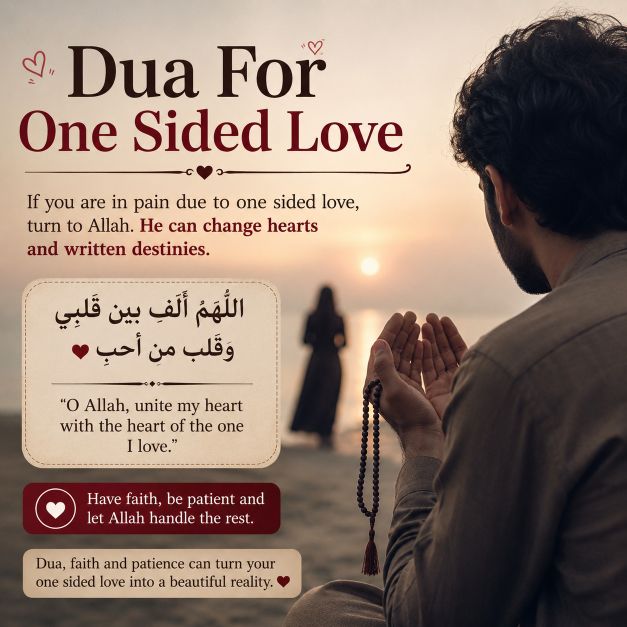
Dua For One Sided Love : How To Perform Dua
You know that feeling when you catch yourself checking your phone every few minutes, hoping it’s them? Or replaying one small moment — a text, a look, a laugh — over and over, trying to figure out if it meant something? Loving someone who doesn’t feel the same way back is exhausting in a way that’s hard to explain to people who haven’t been through it. You go through your day like normal, but there’s this quiet ache underneath everything.
If you’ve searched for “dua for one sided love,” chances are you’re not just looking for a checklist. You want something real — a way to sit with this pain that doesn’t leave you feeling more lost than when you started. So let’s talk about it honestly: what dua actually is, how to perform it step by step, and what it can and can’t do for a heart that’s aching over someone who might never feel the same way.
Let’s Be Honest About What One-Sided Love Really Is
One-sided love isn’t just a crush that fizzles out in a week. Sometimes it’s someone you’ve known for years — a friend, a coworker, someone from your community — and the feelings just… grew, without permission, without asking if you were ready. And now you’re stuck wondering whether to say something, whether to wait, whether to just quietly pray it goes away.
Here’s something I think deserves to be said upfront, because a lot of websites won’t say it: there’s no dua that forces someone else to love you. None. Islam is very clear that hearts belong to Allah — He’s the One described as the “turner of hearts” (muqallib al-quloob), and that’s not just a poetic phrase. It means no ritual, no wazifa, no amount of repetition can override another person’s free will. If a site or a “spiritual healer” tells you otherwise, that’s a red flag, not a solution — and we’ll get into why later.
What dua can do is something quieter, but honestly more powerful: it can change you. It can bring you peace even when the outcome doesn’t change. And sometimes, when the timing and circumstances genuinely align, it can open a halal path forward. That’s the version of hope I want to talk to you about.

So What Exactly Is Dua, And Why Does It Help?
Dua just means calling out to Allah directly — no middleman, no ritual object, nothing complicated. Just you, honest words, and a request. The Prophet Muhammad (peace be upon him) once called dua the very essence of worship. Not a side activity. The core of it.
When you’re aching over someone who doesn’t know (or doesn’t care) how you feel, dua gives you somewhere to put that energy instead of letting it eat you alive. A few things it genuinely does:
- Gives your racing thoughts somewhere to go besides overthinking texts at 2am
- Slowly shifts your focus from “make this happen” to “help me handle this well”
- Builds patience (sabr) in a way that nothing else really does
- Costs nothing, requires no one’s permission, and works anywhere — car, bed, walking, wherever
Compare that to the paid “love spells” and guaranteed rituals floating around online, and it’s not even close. Dua doesn’t promise you a person. It promises you Allah’s attention, and honestly, that’s worth more.
How To Perform Dua For One-Sided Love, Step By Step
Okay, here’s the practical part — how to actually do this.
1. Get honest with your intention first
Before you say a word, sit with what you’re really asking for. Not “make them love me” — that’s not really yours to ask for, and deep down you probably know that. Try something closer to: “Allah, give me what’s genuinely good for me, whether that’s this person or something I haven’t even imagined yet.” That one shift changes everything about how the dua feels.
2. Take wudu
Simple, but it matters. Wudu puts you in a different headspace — more present, more ready to actually talk to Allah instead of just venting into the void.
3. Find a moment where you can actually be alone
Not a rushed five minutes between tasks. Somewhere quiet — your room at night, after everyone’s asleep, wherever you can drop the performance and just be honest.
4. Pray two rakats first, if you can
This is Salat al-Hajah — the prayer of need. It’s not required, but a lot of people find it settles them before they get into the heavier emotional stuff.
5. Start by praising Allah and sending salawat on the Prophet
This isn’t just formality — it’s adab, good manners in how you approach the conversation. You open with gratitude before you open with your ache.
6. Say what’s actually in your heart, in your own words
You don’t need perfect Arabic. You don’t need to sound like a scholar. Something like: “O Allah, You know exactly what I’m carrying right now. If this person is good for me — in this life and beyond — make it easy between us, in a way that’s halal and right. And if not, please take this feeling and replace it with something that actually brings me peace.” Say it the way you’d talk to someone who already knows your whole story — because He does.
7. Bring in a few Quranic duas if you want
Two that a lot of people lean on during emotional seasons like this: the dua in Surah Al-Furqan (25:74), where believers ask for spouses and children who bring them comfort, and the one in Surah Al-Anbiya (21:89), where Prophet Zakariyya asks not to be left alone. Look them up in a translation you trust and read them slowly — understanding what you’re saying matters more than just reciting sounds.
8. End by actually letting go
This is the hardest step, if we’re being real. Something like: “You’re the best of planners, Allah. Whatever you choose for me — help me accept it, and help me feel it as good, even if it doesn’t look like what I pictured.”
9. Keep showing up — don’t treat it as a one-time thing
This isn’t a spell you cast once. Make it part of your routine. After prayers, in the quiet hours of the night, on Fridays. Consistency does something that a single desperate late-night dua just can’t.

When Is the Best Time to Make This Dua?
A few windows are considered especially meaningful in Islamic tradition:
- The last third of the night — when a lot of scholars describe Allah as being especially close to those who call on Him
- Right before the iqamah, in that short window after the adhan
- Right after your five daily prayers, especially in that last sajdah
- Fridays, particularly the final hour before Maghrib
- While you’re fasting — a fasting person’s dua carries a certain weight
None of these guarantee a specific outcome. But they can make the whole practice feel less like a performance and more like an actual connection.
Mistakes People Make Without Realizing It
- Only praying for the other person. Ask for yourself too — your healing, your growth, your peace. This isn’t selfish; it’s necessary.
- Turning to paid “spiritual healers.” If someone’s asking for money and promising a guaranteed result within days, walk away. That’s not Islamic practice — that’s exploitation, and it preys specifically on people who are hurting.
- Praying instead of acting. Dua works alongside real effort, not as a replacement for it. If marriage is genuinely on the table, that usually means an honest conversation, family involvement, or a proper proposal — not silent hoping.
- Giving up too fast, or holding on too long. Both extremes cause pain. A dua that doesn’t “work” the way you hoped isn’t a failure — sometimes the answer is peace, not the outcome you pictured. And sometimes, after a long while, the healthiest dua becomes one for the strength to move on.
Alongside Dua: What Else Actually Helps
Islam doesn’t ask you to just pray and do nothing else. Effort matters too.
- Talk to someone you actually trust — a parent, a close friend, a local imam — especially if there’s a real possibility of marriage.
- Be honest, where it’s appropriate, rather than letting the feeling sit unspoken for years, quietly shaping your life from the shadows.
- Invest in yourself during this time. Not as a distraction, but because becoming a stronger, more grounded version of yourself is never wasted effort, whoever ends up walking into your life.
- Let yourself consider moving on, if there’s genuinely no realistic path forward. Continuing to pray for one person indefinitely, with nothing changing, can keep you stuck in a loop instead of healing.
Please, Be Careful — This Space Is Full of Scams
I want to be direct about this because it matters: “dua for love,” “wazifa to make someone love you,” “black magic removal for love” — these are some of the most heavily exploited search terms online. Watch for:
- Anyone charging money for a “guaranteed” love dua
- Claims about black magic that ask for your money, personal belongings, or a photo of the person you love
- Pressure tactics like “you must act before it’s too late”
A genuine, knowledgeable scholar will teach you a dua for free. None of them will promise you a specific person’s heart. If you want real guidance, go find a trustworthy local imam — not an anonymous account online with a “guaranteed results” tagline.
Common Questions
Is there a dua that makes someone fall in love with you? No — and anyone claiming otherwise isn’t being honest with you. Hearts are in Allah’s control, not ours. What you can genuinely ask for is what’s best for you, whether that includes this person through a halal path, or something else entirely.
How long before a dua like this gets answered? There’s no set timeline, and that’s honestly one of the hardest parts. Scholars describe three ways Allah answers dua: giving you exactly what you asked, giving you something better, or shielding you from a harm you couldn’t see coming. Consistency matters more than speed.
Can I make dua for someone without telling them? Yes, completely. Just keep your intention honest — asking for a good outcome for both of you, not trying to bend their will.
Is it okay to still hope, even after all this? Of course. Just hold that hope with an open hand. Keep making dua, but let yourself prepare for either outcome instead of pinning everything on one.
What if the feelings just won’t go away, even months later? That’s more common than you’d think, and it doesn’t mean anything’s wrong with your dua. Keep asking for peace and clarity, talk to someone you trust about where things actually stand, and give yourself room to explore what a real next step might look like — whether that’s pursuing this properly, or slowly making space to move forward.
One Last Thing
One-sided love has a way of making you feel like your whole life is on pause until this resolves itself. It isn’t. Dua won’t hand you a guarantee, but it will hand you somewhere honest to put your hope — and a way to keep your heart intact while you wait to see what Allah has planned.
If tonight’s the night you want to start, it doesn’t need to be complicated. Take wudu, pray two rakats, and just talk to Allah the way you’d talk to someone who already knows everything you’re carrying. Stay far away from anyone selling you a shortcut. And be patient with yourself — healing, or a real path forward, usually comes one honest dua at a time, not all at once.

One Comment